Saturday, March 6, 2010

Friday, March 5, 2010
Thursday, February 11, 2010
Haiti, Forgive Us

Haiti, Forgive Us
February 11, 2010
By Amy Goodman
Source: t r u t h d i g
Amy Goodman's ZSpace Page
The U.S. Marines occupied
Loans from the World Bank, the International Monetary Fund (IMF) and the Inter-American Development Bank (IDB) imposed “structural adjustment” conditions on
The destruction of Haiti’s rice industry, which was replaced with U.S. government-subsidized rice that Haitians refer to as “Miami rice,” as well as the sale of critical state-owned enterprises, like Haiti’s sole flour mill and cement factory, have left the country dependent on foreign trade and aid, keeping Haiti at a permanent disadvantage.
It is critical now to cancel
Earthquakes alone do not create disasters of the scale now experienced in
Denis Moynihan contributed research to this column.
Amy Goodman is the host of “Democracy Now!,” a daily international TV/radio news hour airing on more than 800 stations in
| From: | Z Net - The Spirit Of Resistance Lives |
|---|---|
| URL: | http://www.zcommunications.org/haiti-forgive-us-by-amy-goodman |
Monday, February 8, 2010
inexcusable.....
from ZNet .....
Study: Hunger in America Jumps ‘Unprecedented’ 46 Percent
70 percent of emergency food centers face threats to their survival
Source: Information Clearing House
Monday, February 08, 2010
February 03, 2010 "ICH" --If there is any indicator of the toll that the Great Recession has taken on the public, it would be the statistics beginning to emerge about hunger in the US.
According to a study from the nation's largest food bank operator, the number of Americans in need of food aid has jumped 46 percent in three years, including a 50 percent jump in the number of children needing food assistance, and a 64 percent increase in hunger in senior citizens' homes.
The study, Hunger in America 2010, found that 37 million people, or roughly one in eight US residents, received food aid in 2009. That's a 46 percent jump from a similar survey carried out in 2006.
"Clearly, the economic recession, resulting in dramatically increasing unemployment nationwide, has driven unprecedented, sharp increases in the need for emergency food assistance and enrollment in federal nutrition programs," said Vicki Escarra, president and CEO of Feeding America, which operates some 200 food banks across the country.
The study found a growing number of people having to make difficult choices about what to spend their dwindling dollars on, with the rising cost of health care a major contributing factor to hunger.
"More than 46 percent of clients served report having to choose between paying for utilities or heating fuel and food; 39 percent said they had to choose between paying for rent or a mortgage and food; 34 percent report having to choose between paying for medical bills and food; and 35 percent must choose between transportation and food," the study reports.
"It is morally reprehensible that we live in the wealthiest nation in the world where one in six people are struggling to make choices between food and other basic necessities," Escarra said in a statement.
She added that "[t]hese are choices that no one should have to make, but particularly households with children. Insufficient nutrition has adverse effects on the physical, behavioral and mental health, and academic performance of children."
Feeding America's study is just the latest to show an alarming trend line for hunger in the United States.
Last week, a report (PDF) from the Food Research and Action Center found that nearly one in five in the US -- 18.5 percent -- report having gone hungry in the past year, up from 16.3 percent at the start of 2008. Households with children were even likelier to experience hunger, with nearly a quarter reporting hunger in the past year.
Perhaps worst of all, the Feeding America study finds that 70 percent of emergency food centers are reporting "one or more problems that threaten their ability to continue operating."
"While we have reached many more people over the past four years, the need of hungry Americans far outpaces our current level of service," Escarra said.
Friday, February 5, 2010
The Corporate Takeover of U.S. Democracy
Source: ITT
Thursday, February 04, 2010
Jan. 21, 2010, will go down as a dark day in the history of U.S. democracy, and its decline.
On that day the U.S. Supreme Court ruled that the government may not ban corporations from political spending on elections—a decision that profoundly affects government policy, both domestic and international.
The decision heralds even further corporate takeover of the U.S. political system.
To the editors of The New York Times, the ruling “strikes at the heart of democracy” by having “paved the way for corporations to use their vast treasuries to overwhelm elections and intimidate elected officials into doing their bidding.”
The court was split, 5-4, with the four reactionary judges (misleadingly called “conservative”) joined by Justice Anthony M. Kennedy. Chief Justice John G. Roberts Jr. selected a case that could easily have been settled on narrow grounds and maneuvered the court into using it to push through a far-reaching decision that overturns a century of precedents restricting corporate contributions to federal campaigns.
Now corporate managers can in effect buy elections directly, bypassing more complex indirect means. It is well-known that corporate contributions, sometimes packaged in complex ways, can tip the balance in elections, hence driving policy. The court has just handed much more power to the small sector of the population that dominates the economy.
Political economist Thomas Ferguson’s “investment theory of politics” is a very successful predictor of government policy over a long period. The theory interprets elections as occasions on which segments of private sector power coalesce to invest to control the state.
The Jan. 21 decision only reinforces the means to undermine functioning democracy.
The background is enlightening. In his dissent, Justice John Paul Stevens acknowledged that “we have long since held that corporations are covered by the First Amendment”—the constitutional guarantee of free speech, which would include support for political candidates.
In the early 20th century, legal theorists and courts implemented the court’s 1886 decision that corporations—these “collectivist legal entities”—have the same rights as persons of flesh and blood.
This attack on classical liberalism was sharply condemned by the vanishing breed of conservatives. Christopher G. Tiedeman described the principle as “a menace to the liberty of the individual, and to the stability of the American states as popular governments.”
Morton Horwitz writes in his standard legal history that the concept of corporate personhood evolved alongside the shift of power from shareholders to managers, and finally to the doctrine that “the powers of the board of directors “are identical with the powers of the corporation.” In later years, corporate rights were expanded far beyond those of persons, notably by the mislabeled “free trade agreements.” Under these agreements, for example, if General Motors establishes a plant in Mexico, it can demand to be treated just like a Mexican business (“national treatment”)—quite unlike a Mexican of flesh and blood who might seek “national treatment” in New York, or even minimal human rights.
A century ago, Woodrow Wilson, then an academic, described an America in which “comparatively small groups of men,” corporate managers, “wield a power and control over the wealth and the business operations of the country,” becoming “rivals of the government itself.”
In reality, these “small groups” increasingly have become government’s masters. The Roberts court gives them even greater scope.
The Jan. 21 decision came three days after another victory for wealth and power: the election of Republican candidate Scott Brown to replace the late Sen. Edward M. Kennedy, the “liberal lion” of Massachusetts. Brown’s election was depicted as a “populist upsurge” against the liberal elitists who run the government.
The voting data reveal a rather different story.
High turnouts in the wealthy suburbs, and low ones in largely Democratic urban areas, helped elect Brown. “Fifty-five percent of Republican voters said they were `very interested’ in the election,” The Wall St. Journal/NBC poll reported, “compared with 38 percent of Democrats.”
So the results were indeed an uprising against President Obama’s policies: For the wealthy, he was not doing enough to enrich them further, while for the poorer sectors, he was doing too much to achieve that end.
The popular anger is quite understandable, given that the banks are thriving, thanks to bailouts, while unemployment has risen to 10 percent.
In manufacturing, one in six is out of work—unemployment at the level of the Great Depression. With the increasing financialization of the economy and the hollowing out of productive industry, prospects are bleak for recovering the kinds of jobs that were lost.
Brown presented himself as the 41st vote against healthcare—that is, the vote that could undermine majority rule in the U.S. Senate.
It is true that Obama’s healthcare program was a factor in the Massachusetts election. The headlines are correct when they report that the public is turning against the program.
The poll figures explain why: The bill does not go far enough. The Wall St. Journal/NBC poll found that a majority of voters disapprove of the handling of healthcare both by the Republicans and by Obama.
These figures align with recent nationwide polls. The public option was favored by 56 percent of those polled, and the Medicare buy-in at age 55 by 64 percent; both programs were abandoned.
Eighty-five percent believe that the government should have the right to negotiate drug prices, as in other countries; Obama guaranteed Big Pharma that he would not pursue that option.
Large majorities favor cost-cutting, which makes good sense: U.S. per capita costs for healthcare are about twice those of other industrial countries, and health outcomes are at the low end.
But cost-cutting cannot be seriously undertaken when largesse is showered on the drug companies, and healthcare is in the hands of virtually unregulated private insurers—a costly system peculiar to the U.S.
Tuesday, January 26, 2010
Mr. Fall Downly....
... is back in town, heads up (or down).
should have seen it coming too. i even thought to myself during the commute this morning, "i've been cruising". this only crossed my mind because the roads have been so shitty, and until relatively recently i've been taking it pretty easy while riding.
well, as has happened the past couple years about this point in our winter, i get much more comfortable with cruising around in this crap.
this resulted in me flying around a, what appeared to be, clear (ie not icey) corner, with what is apparently too much momentum.
thanks to the hakkapeliitta mounted on my front wheel, is was about the most gentle "oh shit, here comes the tarmac" moment this past year (and there've been plenty).
am especially glad there wasn't a mini-van following me around that corner this time.
should have seen it coming too. i even thought to myself during the commute this morning, "i've been cruising". this only crossed my mind because the roads have been so shitty, and until relatively recently i've been taking it pretty easy while riding.
well, as has happened the past couple years about this point in our winter, i get much more comfortable with cruising around in this crap.
this resulted in me flying around a, what appeared to be, clear (ie not icey) corner, with what is apparently too much momentum.
thanks to the hakkapeliitta mounted on my front wheel, is was about the most gentle "oh shit, here comes the tarmac" moment this past year (and there've been plenty).
am especially glad there wasn't a mini-van following me around that corner this time.
Wednesday, January 20, 2010
counterpunch
January 20, 2010
A Richly Deserved Humiliation
Coakley Loses and a Good Job Too
By ALEXANDER COCKBURN
Republican Scott Brown takes over a seat held by the Kennedy family for over half a century and the dark cloud already hovering over Obama's White House thickens. By any measure the energetic Brown's emphatic defeat of Martha Coakley, believed only a month ago to be a sure thing as Ted Kennedy's replacement, is a disaster for the Democratic Party and for President Obama.
Coakley, a former prosecutor and attorney general of Massachusetts, ran a dumb, complacent campaign, allowing Brown, a state senator, to charge that she seemed to believe she had an inherent right to the seat. Coakley ladled out platitudes; Brown, pelting about the Commonwealth in a manly GMC truck, made the Democrats' health reform bill his prime issue, which was scarcely rocket science, since people of moderate income accurately believe that "reform" is going to cost them money, with zero improvement in overall service.
A year after his inauguration Obama has disappointed so many constituencies that a rebuke by the voters was inevitable. Yesterday it came in Massachusetts, often categorized as the most liberal in the union. This is entirely untrue. It's a disgusting sinkhole of racism and vulgar prejudice, as five minutes in any taxi in the state, listening to Talk Radio or reading the local newspaper, will attest.
Brown's achievement is not novel. His type of Republican has been elected governor in Massachusetts three or four times in the last 18 years by the real "majority party" --which is the "unenrolled" independents who are 1 and 1/2 times the size of Democrats in number among registered voters and tower over the Republicans of whom less than 12 per cent are registered as such.
CounterPuncher Steve Early, a labor organizer in the state wrote to us on Monday that Brown is in the mould of two recent Republican governors of Massachusetts, William Weld , and Paul Celluci, the latter two actually being backed by later Change to Win local affiliates like HERE Local 26 and the Teamsters. These were genial, likeable, clean-cut jocks, presenting themselves to independent voters as a much needed public rebuke to "an increasingly corrupt, arrogant or personally screwed up Beacon Hill clique of Democrats (see recent spate of House and Senate member/leader indictments, jailings, and/or resignations pending trial). A lot of folks, at the moment, are again just plain pissed about the self-serving political class of Democratic Donkeys who run our one-party state, including the now unpopular Obama pre-cursor, Deval Patrick."
Because the Democratic majority in the US senate is now reduced to 59, the common prediction is that the Democrats' health reform bill is doomed, since it takes 60 votes to override a filibuster, which the Republicans would mount to kill the bill. More likely is that the insurance companie , (which dictated the basic terms of the "reform" and stands to gain millions of new customers who will be forced by law to take out health insurance), will be loath to throw away months of successful lobbying and will dictate some new "compromise" that will allow both Republicans and Democrats to claim victory. Obama will delightedly sign any insurance bill landing on his desk bearing the necessary label, "reform".
Certainly Coakley's resounding defeat is grim news for Democratic politicians limbering up for the midterm elections this coming fall. The parallel is with the midterms of 1994, when voters, furious at the bumbling failures of Clinton's first two years, handed both the senate and the house to Republicans for the first time in decades. Obama has caused fury and disillusion across the spectrum. The nutball right bizarrely portrays him as a mutant offspring of the Prophet Mohammed and Karl Marx, demonstrating that cretinism flows more strongly than ever in Uncle Sam's bloodstream. The Republican small business crowd tremble at the huge deficits. The independents see no trace of the invigorating change pledged by Obama. Working people in the labor unions who supplied the footsoldiers for Obama's campaign see no improvement in their economic condition. Everyone knows that Obama is the champion of bankers, not bankrupts. The liberals morosely list twelve months of disasters, from a wider war in Afghanistan, to major betrayals of pledges to restore constitutional restrains after eight years of abuse by Bush and Cheney.
Obama richly deserves the rebuke from Massachusetts. Armed with a nation's fervent hopes a year ago, he spurned the unrivalled opportunity offered by economic crisis to do what he pledged: usher in substantive change. He's done exactly the opposite . Wall Street has been given the green light to continue with business as usual. The stimulus package was far too weak. The opportunity for financial reform has passed. Trillions will be wasted in Afghanistan.
A final note on Coakley. She rose to political prominence by peculiarly vicious grandstanding as a prosecutor, winning a conviction of 19-year old child minder Louise Woodward for shaking a baby to death. An outraged judge later freed Woodward, reducing her sentence to less than a year of time served. Then Coakley went after headlines in child abuse cases. Innocent people are still rotting in prison as a consequence of Coakley's misuse of her office. For this alone, regardless of the setback the Democrats richly deserved, I rejoice in her humiliation.
A Richly Deserved Humiliation
Coakley Loses and a Good Job Too
By ALEXANDER COCKBURN
Republican Scott Brown takes over a seat held by the Kennedy family for over half a century and the dark cloud already hovering over Obama's White House thickens. By any measure the energetic Brown's emphatic defeat of Martha Coakley, believed only a month ago to be a sure thing as Ted Kennedy's replacement, is a disaster for the Democratic Party and for President Obama.
Coakley, a former prosecutor and attorney general of Massachusetts, ran a dumb, complacent campaign, allowing Brown, a state senator, to charge that she seemed to believe she had an inherent right to the seat. Coakley ladled out platitudes; Brown, pelting about the Commonwealth in a manly GMC truck, made the Democrats' health reform bill his prime issue, which was scarcely rocket science, since people of moderate income accurately believe that "reform" is going to cost them money, with zero improvement in overall service.
A year after his inauguration Obama has disappointed so many constituencies that a rebuke by the voters was inevitable. Yesterday it came in Massachusetts, often categorized as the most liberal in the union. This is entirely untrue. It's a disgusting sinkhole of racism and vulgar prejudice, as five minutes in any taxi in the state, listening to Talk Radio or reading the local newspaper, will attest.
Brown's achievement is not novel. His type of Republican has been elected governor in Massachusetts three or four times in the last 18 years by the real "majority party" --which is the "unenrolled" independents who are 1 and 1/2 times the size of Democrats in number among registered voters and tower over the Republicans of whom less than 12 per cent are registered as such.
CounterPuncher Steve Early, a labor organizer in the state wrote to us on Monday that Brown is in the mould of two recent Republican governors of Massachusetts, William Weld , and Paul Celluci, the latter two actually being backed by later Change to Win local affiliates like HERE Local 26 and the Teamsters. These were genial, likeable, clean-cut jocks, presenting themselves to independent voters as a much needed public rebuke to "an increasingly corrupt, arrogant or personally screwed up Beacon Hill clique of Democrats (see recent spate of House and Senate member/leader indictments, jailings, and/or resignations pending trial). A lot of folks, at the moment, are again just plain pissed about the self-serving political class of Democratic Donkeys who run our one-party state, including the now unpopular Obama pre-cursor, Deval Patrick."
Because the Democratic majority in the US senate is now reduced to 59, the common prediction is that the Democrats' health reform bill is doomed, since it takes 60 votes to override a filibuster, which the Republicans would mount to kill the bill. More likely is that the insurance companie , (which dictated the basic terms of the "reform" and stands to gain millions of new customers who will be forced by law to take out health insurance), will be loath to throw away months of successful lobbying and will dictate some new "compromise" that will allow both Republicans and Democrats to claim victory. Obama will delightedly sign any insurance bill landing on his desk bearing the necessary label, "reform".
Certainly Coakley's resounding defeat is grim news for Democratic politicians limbering up for the midterm elections this coming fall. The parallel is with the midterms of 1994, when voters, furious at the bumbling failures of Clinton's first two years, handed both the senate and the house to Republicans for the first time in decades. Obama has caused fury and disillusion across the spectrum. The nutball right bizarrely portrays him as a mutant offspring of the Prophet Mohammed and Karl Marx, demonstrating that cretinism flows more strongly than ever in Uncle Sam's bloodstream. The Republican small business crowd tremble at the huge deficits. The independents see no trace of the invigorating change pledged by Obama. Working people in the labor unions who supplied the footsoldiers for Obama's campaign see no improvement in their economic condition. Everyone knows that Obama is the champion of bankers, not bankrupts. The liberals morosely list twelve months of disasters, from a wider war in Afghanistan, to major betrayals of pledges to restore constitutional restrains after eight years of abuse by Bush and Cheney.
Obama richly deserves the rebuke from Massachusetts. Armed with a nation's fervent hopes a year ago, he spurned the unrivalled opportunity offered by economic crisis to do what he pledged: usher in substantive change. He's done exactly the opposite . Wall Street has been given the green light to continue with business as usual. The stimulus package was far too weak. The opportunity for financial reform has passed. Trillions will be wasted in Afghanistan.
A final note on Coakley. She rose to political prominence by peculiarly vicious grandstanding as a prosecutor, winning a conviction of 19-year old child minder Louise Woodward for shaking a baby to death. An outraged judge later freed Woodward, reducing her sentence to less than a year of time served. Then Coakley went after headlines in child abuse cases. Innocent people are still rotting in prison as a consequence of Coakley's misuse of her office. For this alone, regardless of the setback the Democrats richly deserved, I rejoice in her humiliation.
Sunday, December 6, 2009

Saturday, November 7, 2009

check it
http://www.hulu.com/watch/107001/steal-this-film
and then go ride, its going to be a gorgeous weekend.
Wednesday, November 4, 2009
Be weary of intersections....
.... even when you have the green light, since there may be a giant white 80's Caprice Classic flying through the very same intersection against a/their red light.
this in turn may/will cause your asshole to pucker tighter than someone with a really tiny asshole, while you yell fruitlessly.
and as the car passes, a dumb-struck 'oh-shit' look grows on the drivers face.
you may even see this car again just a few blocks later. and against your better judgement, decide to chase them down and let them know how much of an incredibly fucking stupid, reckless, piece of shit they are.
the nice thing though, is that the beer in your fridge will taste just that much better.
be safe out their people
Tuesday, November 3, 2009
HFF-13


In summary, to quote a bearded nun:
"1) Patty should quit her job along with all other endeavors that don't involve carmel making.
2) Never bet a food service worker that she can not identify what a costume is that has to do with food.
3) Never try to pop a wheelie at 2:02 am at the corner of 2nd and 2nd on the day the clocks reset, because your chain will snap and you will have to scooter yourself home.
4) People are incredibly reluctant to accept baked goods from nuns with a five o'clock shadow, particularly if said nun is trying to give away 700 cookies, because that is just way too many damn cookies.
5) People are not, however, reluctant to exclaim the various sexual acts they have always dreamed of performing on a nun.
6) When you can't find your gloves check your pockets first.
7) Unless they are made with pot or mushrooms 700 cookies are just too damn many cookies.
8) You can NOT steer a tandem from the rear seat, even if you can turn the handle bar. Actually, turning the handle bars makes things worse.
9) When walking up and down muddy creek beds in the dark, take baby steps in case it is slippery or let Clay go ahead of you so you can tell the slick spots based on where he falls down.
10) Anything more the 700 cookies is just way too many damn cookies.
Those of you that were in attendance likely learned these lesson's with me or in some cases because of me. Hopefully, those of you that missed out can learn from my mistakes. I'm already working on an alternative to cookies for next year so far jello shots and homemade burritos is the lead contender. So we may finnally find out if there truely is always room for jello. I should mention the 11th lesson I learned from our own Stevie Bergman was that I have some pretty horrible ideas. "
more from the folks at 'we walk st.p'
Sunday, November 1, 2009
hmm

Depression link to processed food
Eating a diet high in processed food increases the risk of depression, research suggests.
What is more, people who ate plenty of vegetables, fruit and fish actually had a lower risk of depression, the University College London team found.
Data on diet among 3,500 middle-aged civil servants was compared with depression five years later, the British Journal of Psychiatry reported.
The team said the study was the first to look at the UK diet and depression.
“ The UK population is consuming less nutritious, fresh produce and more saturated fats and sugars ”
Dr Andrew McCulloch, Mental Health Foundation
Dr Andrew McCulloch, Mental Health Foundation
They split the participants into two types of diet - those who ate a diet largely based on whole foods, which includes lots of fruit, vegetables and fish, and those who ate a mainly processed food diet, such as sweetened desserts, fried food, processed meat, refined grains and high-fat dairy products.
After accounting for factors such as gender, age, education, physical activity, smoking habits and chronic diseases, they found a significant difference in future depression risk with the different diets.
Those who ate the most whole foods had a 26% lower risk of future depression than those who at the least whole foods.
By contrast people with a diet high in processed food had a 58% higher risk of depression than those who ate very few processed foods.
Mediterranean diet
Although the researchers cannot totally rule out the possibility that people with depression may eat a less healthy diet they believe it is unlikely to be the reason for the findings because there was no association with diet and previous diagnosis of depression.
Study author Dr Archana Singh-Manoux pointed out there is a chance the finding could be explained by a lifestyle factor they had not accounted for.
"There was a paper showing a Mediterranean diet was associated with a lower risk of depression but the problem with that is if you live in Britain the likelihood of you eating a Mediterranean diet is not very high.
"So we wanted to look at bit differently at the link between diet and mental health."
It is not yet clear why some foods may protect against or increase the risk of depression but scientists think there may be a link with inflammation as with conditions such as heart disease.
Dr Andrew McCulloch, chief executive of the Mental Health Foundation, said: "This study adds to an existing body of solid research that shows the strong links between what we eat and our mental health.
"Major studies like this are crucial because they hold the key to us better understanding mental illness."
He added people's diets were becoming increasingly unhealthy.
"The UK population is consuming less nutritious, fresh produce and more saturated fats and sugars.
"We are particularly concerned about those who cannot access fresh produce easily or live in areas where there are a high number of fast food restaurants and takeaways."
Margaret Edwards, head of strategy at the mental health charity SANE, said: "Physical and mental health are closely related, so we should not be too surprised by these results, but we hope there will be further research which may help us to understand more fully the relationship between diet and mental health."
Print Sponsor
Advertisement
Tuesday, October 20, 2009
right smack dab on the head....
Monday, October 12, 2009
goggles....
... wish i had worn them today. it may only be mid-october, but it looks like late november.
thinking i may get a whistle, had one truck and one car pull out in front of me on my way in this morning.
thinking i may get a whistle, had one truck and one car pull out in front of me on my way in this morning.
Tuesday, July 14, 2009
2 months?!
After two months of 'nada', I'm hoping there aren't any grand expectations for what might be spouted on this here 'webloggery'.
summer's flying, but my cohorts and i have managed to do a decent job of avoiding the bummer life, if i may borrow the term.
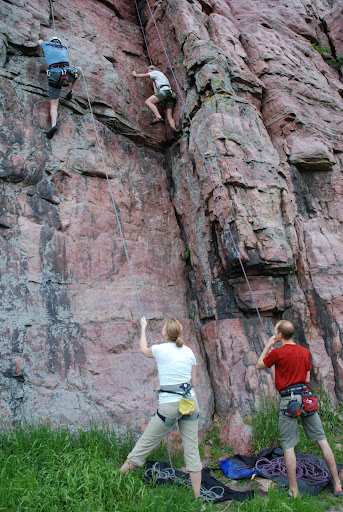
there are a bunch of photos in the following...the climbing pics were stolen from Patty, the Bergman's, and Mrs Austin.
all the good photos from the Chippewa triathlon came from my buddy Tony.
enjoy!

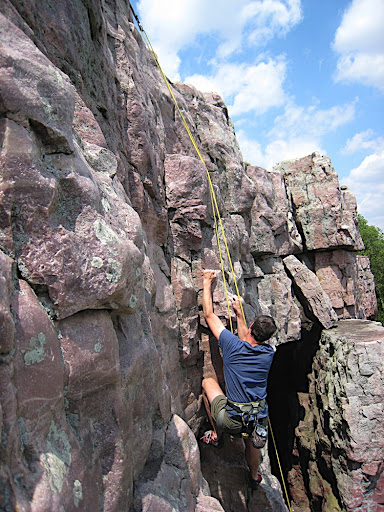 Kelly demonstrating "how its done"
 Steph laying it back
 andrea (above) steve (below) - this ceiling/balcony/whatever gave us all trouble

 Patricia not seeming terribly convinced
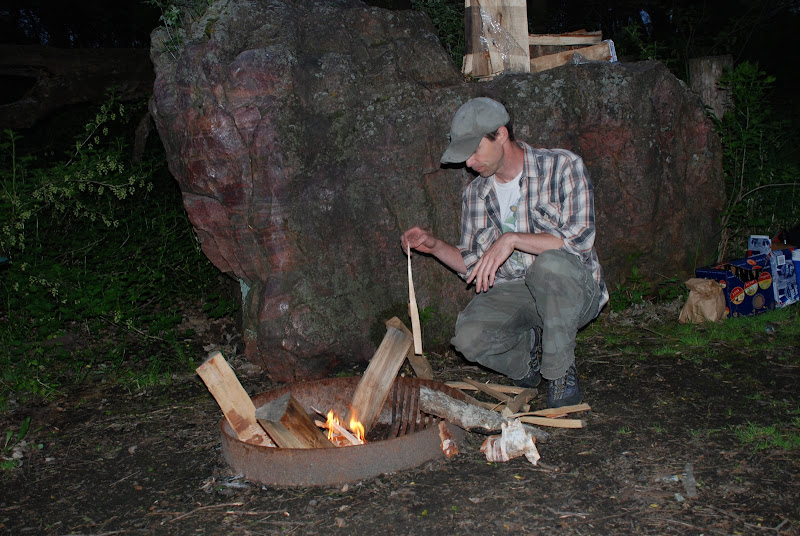 Kelly playing in the fire
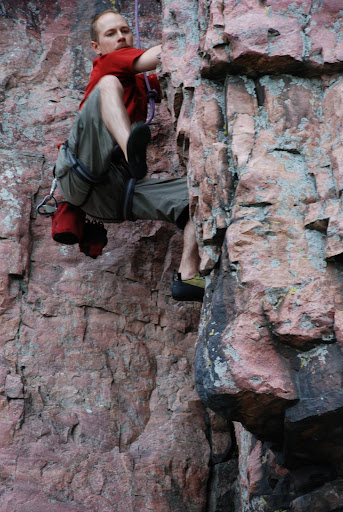 Jared stomping it out

The next few are from the Chippewa Triathlon. Now, i'm no 'triathlete' by any stretch of the word, but a co-worker asked me if i'd like to do the bike portion as part of a relay. It sounded like a good time so I said "Sure!"
It turned out to be an awesome time, and we managed to take 3rd in our division (competitive relay). The "mountain bike" course had a bit of everything, which made for an exciting and challenging 28 mile ride. What made it even more challening was the rain we had gotten the night before, and sporadically during the race. Tons of mud, sand, some single track, about 9 miles of paved trail, most of which ran through the Chippewa National Forest.
Am hoping we get the same team back again next year.
i'll let the photos talk now....
 This is the switch-off point between the canoe and bike portion of the race.
It was cool out, about 50, but that was for the best. I was so anxious i was taking a piss
about every 5 minutes.

 The first canoers in
 me coming into the bike finish... i dont think i was smiling.... the last 4 miles i had been chasing a dude i couldn't catch. my comp said i was going ~26 mph, and i wasn't gaining any ground. but after riding that hard through that gnarly of terrain for two hours, i shouldn't be too suprised.
 this dude came in shortly after i did
 washing off the 'check and her new wheels. rick was a bit nervous about me running
new parts for a race, but i told him we had nothing to worry about. Thanks Jim!
 Tony taking off for the run
 Tony finishing the 7 mile run in 46 minutes. it was the farthest he had ever run.
 Rick enjoying the northern minnesota sun

 gathering wood after the potluck
And a random photo, just to remind you how awesome cargo bikes are.

summer's flying, but my cohorts and i have managed to do a decent job of avoiding the bummer life, if i may borrow the term.
there are a bunch of photos in the following...the climbing pics were stolen from Patty, the Bergman's, and Mrs Austin.
all the good photos from the Chippewa triathlon came from my buddy Tony.
enjoy!
 Kelly demonstrating "how its done"
 Steph laying it back
 andrea (above) steve (below) - this ceiling/balcony/whatever gave us all trouble
 Patricia not seeming terribly convinced
 Kelly playing in the fire
 Jared stomping it out
The next few are from the Chippewa Triathlon. Now, i'm no 'triathlete' by any stretch of the word, but a co-worker asked me if i'd like to do the bike portion as part of a relay. It sounded like a good time so I said "Sure!"
It turned out to be an awesome time, and we managed to take 3rd in our division (competitive relay). The "mountain bike" course had a bit of everything, which made for an exciting and challenging 28 mile ride. What made it even more challening was the rain we had gotten the night before, and sporadically during the race. Tons of mud, sand, some single track, about 9 miles of paved trail, most of which ran through the Chippewa National Forest.
Am hoping we get the same team back again next year.
i'll let the photos talk now....
 This is the switch-off point between the canoe and bike portion of the race.
It was cool out, about 50, but that was for the best. I was so anxious i was taking a piss
about every 5 minutes.

 The first canoers in
 me coming into the bike finish... i dont think i was smiling.... the last 4 miles i had been chasing a dude i couldn't catch. my comp said i was going ~26 mph, and i wasn't gaining any ground. but after riding that hard through that gnarly of terrain for two hours, i shouldn't be too suprised.
 this dude came in shortly after i did
 washing off the 'check and her new wheels. rick was a bit nervous about me running
new parts for a race, but i told him we had nothing to worry about. Thanks Jim!
 Tony taking off for the run
 Tony finishing the 7 mile run in 46 minutes. it was the farthest he had ever run.
 Rick enjoying the northern minnesota sun
 gathering wood after the potluck
And a random photo, just to remind you how awesome cargo bikes are.

Wednesday, May 13, 2009
this is what...
$130 worth of groceries looks like on an xtracycle......
this is what it looks like on the ground.....
 not REALLY my bad, when i lifted the bags out of the right freeloader, the kickstand sunk straight into ground.
do yourself a favor and read the next post

this is what it looks like on the ground.....
 not REALLY my bad, when i lifted the bags out of the right freeloader, the kickstand sunk straight into ground.
do yourself a favor and read the next post
http://twincities.indymedia.org
Where there's smoke....
Anarchism after the RNC
I.
We've got the numbers, they've got the guns..
Our chants reverberated under the St. Paul skyway. The 2008 RNC protests were underway, the culmination of two years of anarchist/anti-authoritarian organizing materializing before our eyes. For once, we were many, and they were few... or maybe not. With 3500 cops and an uncounted number of National Guardsmen and Secret Service agents on the streets, this time they had both the guns and the numbers.
Overwhelming force was only one element of the state's repression strategy. The main hub of direct action coordination– the RNC Welcoming Committee– had been infiltrated by at least one undercover cop and two paid informants almost a year prior. On Friday night, the hammer came down with a raid on the St. Paul Convergence Center. Cops busted in the doors with guns drawn, forcing about 100 people to the ground, zip-tying them, and then photographing everyone and taking IDs. What a start to the weekend...
The next morning, I got a call from a friend alerting me that the cops were raiding anarchist houses across south Minneapolis. Eventually, four houses had been raided, and eight members of the Welcoming Committee jailed.
Over the next week, over 800 people would be arrested in conjunction with the protests. Many would be injured by rubber bullets, concussion grenades, tear gas, pepper spray, and other weaponry. The state imposed a high cost on expressing dissent....
rest HERE....
Anarchism after the RNC
I.
We've got the numbers, they've got the guns..
Our chants reverberated under the St. Paul skyway. The 2008 RNC protests were underway, the culmination of two years of anarchist/anti-authoritarian organizing materializing before our eyes. For once, we were many, and they were few... or maybe not. With 3500 cops and an uncounted number of National Guardsmen and Secret Service agents on the streets, this time they had both the guns and the numbers.
Overwhelming force was only one element of the state's repression strategy. The main hub of direct action coordination– the RNC Welcoming Committee– had been infiltrated by at least one undercover cop and two paid informants almost a year prior. On Friday night, the hammer came down with a raid on the St. Paul Convergence Center. Cops busted in the doors with guns drawn, forcing about 100 people to the ground, zip-tying them, and then photographing everyone and taking IDs. What a start to the weekend...
The next morning, I got a call from a friend alerting me that the cops were raiding anarchist houses across south Minneapolis. Eventually, four houses had been raided, and eight members of the Welcoming Committee jailed.
Over the next week, over 800 people would be arrested in conjunction with the protests. Many would be injured by rubber bullets, concussion grenades, tear gas, pepper spray, and other weaponry. The state imposed a high cost on expressing dissent....
rest HERE....
Tuesday, May 5, 2009
The People's Bailout: A May Day Speech*
By Paul Street
..... {rest HERE}
I'd like to thank Wild Rose Rebellion and others who participated in planing this May Day event for inviting me to speak on this day that so few Americans have been allowed to know as the original labor day, born right here in the United States in connection with the struggle for the Eight Hour Day - for a human work day.
TIME, DEMOCRACY, AND CAPITALISM
You know, if you go back and look at the original arguments that working people and their organizations - unions - made for shorter hours, you find something very interesting. They didn't just talk about the physical and psychological and family problems that came with constant overwork under the control of their bosses. They didn't just talk about the fact that the bosses cheated them out of extra hours and minutes every day. They didn't just talk about how shorter hours would mean spreading out the work which would mean more jobs and thus less unemployment and poverty for working people.
They talked about all of that but that also said two others things that are worth remember and reflecting upon today. First, they argued that you can't have a democracy if people don't have the time to participate in it. They said that the democratic promises of the American Revolution didn't mean anything for people who are denied the free time and the energy to study and discuss and organize and form associations about the great issues of the day.
..... {rest HERE}
Subscribe to:
Posts (Atom)


